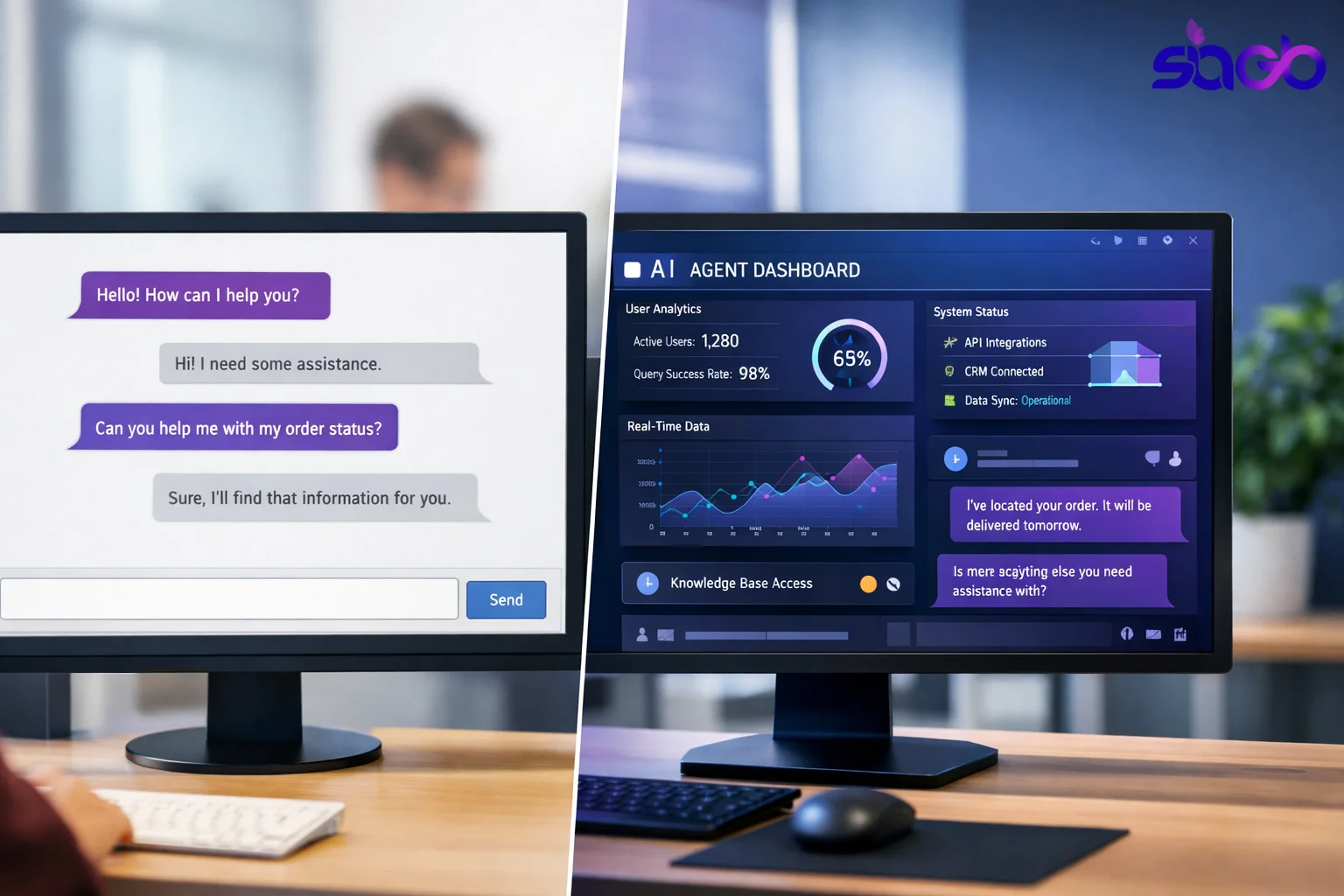
Voice AI is transforming call centres across Australia. Instead of frustrating phone trees and endless hold music, businesses are deploying intelligent voice systems that actually solve problems. Yet most Australian companies are still running phone systems designed in the early 2000s.
That’s changing fast.
The Call Centre Problem
Australian businesses spend over $12 billion annually on call centre operations. As voice AI call centre adoption grows across Australia, companies are realising that a huge portion of that spend goes toward handling calls that are simple, repetitive, and predictable.
Think about it. How many calls does your business receive that are some version of “What are your opening hours?” or “Can I reschedule my appointment?” or “Where’s my order?” These calls don’t require human judgement. They require information retrieval and basic actions.
Yet each one ties up a trained agent for 3 to 7 minutes. At an average cost of $8 to $12 per call, those routine enquiries add up to a staggering expense.
Meanwhile, the calls that actually need a human, the complex complaints, the sensitive situations, the high-value sales conversations, get stuck in a queue behind someone asking about parking.
The Australian Contact Centre Association reports that average wait times in Australian call centres hit 6 minutes and 42 seconds in 2025. That number is honestly embarrassing for the industry. That’s not a number that makes customers feel valued.
What Voice AI Actually Does
Voice AI isn’t the robotic “I didn’t understand that, please try again” system you’re picturing. That was IVR (Interactive Voice Response), and it deserved every bit of frustration directed at it.
Modern voice AI is fundamentally different. It uses natural language understanding, speech-to-text, text-to-speech, and large language models to have genuine conversations. Not scripted decision trees. Actual conversations where the AI understands intent, handles context, and responds naturally.
Here’s what that looks like in practice:
Caller: “Hi, I need to move my appointment from Thursday to sometime next week. Preferably morning.”
Voice AI: “No worries. I can see your appointment with Dr Patel on Thursday the 26th at 2pm. I’ve got availability on Monday the 30th at 9:30am or Wednesday the 1st at 10am. Which works better for you?”
No menu trees. No “press 1.” No being transferred three times. The AI understood the request, checked the calendar, and offered options. Done in 30 seconds.
The voice itself has improved dramatically too. Modern text-to-speech systems produce voices that are natural, warm, and almost indistinguishable from a human agent on a phone line. Actually, let me rephrase. In a blind test, most people can’t tell the difference. On a phone line with typical audio compression, the gap is essentially zero. We’re well past the robotic monotone era.
Five Use Cases That Are Working Right Now
1. Appointment Scheduling and Rescheduling
This is the single highest-impact use case for voice AI in Australia right now. Healthcare clinics, dental practices, allied health, salons, trades businesses, anyone running an appointment book.
Voice AI handles the entire booking flow. New appointments, rescheduling, cancellations, confirmations. It checks availability in real time, sends SMS confirmations, and adds reminders to the calendar.
One allied health network we worked with reduced their front-desk phone time by 62% within three months of deploying voice AI. That result exceeded expectations. Their receptionists went from spending 5 hours a day on the phone to spending that time on patient care and in-person support.
Typical cost: $500 to $2,000 per month depending on call volume.
2. FAQ and Information Handling
Every business has a set of questions that come in dozens of times a day. Opening hours, location, pricing, policies, product availability. Voice AI answers these instantly, 24 hours a day, 7 days a week.
But here’s where it gets interesting. Unlike a static FAQ page, voice AI can handle follow-up questions. “What time do you close on Saturday?” followed by “And is the car park free?” followed by “Can I bring my dog?” It maintains context across the conversation.
Typical cost: $300 to $1,500 per month.
3. Intelligent Call Routing
What if every call that reached a human agent came with full context? Voice AI can qualify callers, understand their issue, check their account status, and route them to the right person, all before the agent picks up.
The agent sees a screen pop: “Sarah from Westfield account, calling about invoice #4521 which is 15 days overdue, requesting a payment plan.” Compare that to a blind transfer where the agent starts from scratch.
Businesses using AI-powered call routing report a 40% reduction in average handle time (which is saying something, given how stubbornly high handle times have been in Australian call centres). That’s because agents spend less time figuring out the problem and more time solving it.
Typical cost: $800 to $3,000 per month.
4. After-Hours Call Handling
How many calls does your business miss outside of business hours? For most Australian businesses, it’s 30% to 40% of all inbound calls. Each missed call is a potentially lost customer.
Voice AI doesn’t clock off. It handles after-hours calls with the same capability as daytime ones. It can take messages, book appointments, answer questions, process simple requests, and flag urgent issues for immediate human follow-up.
A property management company we work with was missing 35% of maintenance requests because they came in after 5pm. Their voice AI now captures every single one, triages by urgency, and dispatches emergency tradespeople when needed.
Typical cost: $400 to $1,500 per month.
5. Call Summarisation and Documentation
Even when a human agent handles the call, voice AI adds value. Real-time transcription and AI-powered summarisation means every call gets documented automatically. No more manual notes. No more “I forgot to log that call.”
The AI generates structured summaries: caller name, issue category, actions taken, follow-up required, sentiment. These feed directly into your CRM.
For compliance-heavy industries, this is transformative. Every conversation is recorded, transcribed, and summarised. Audit trails are automatic.
Typical cost: $200 to $1,000 per month.
Here’s how those five use cases compare at a glance, along with the typical monthly cost for each.
| Use case | What it handles | Typical monthly cost |
|---|---|---|
| Appointment scheduling and rescheduling | Bookings, rescheduling, cancellations, confirmations, reminders | $500 to $2,000 |
| FAQ and information handling | Opening hours, location, pricing, policies, follow-up questions | $300 to $1,500 |
| Intelligent call routing | Caller qualification, account checks, context-rich transfers | $800 to $3,000 |
| After-hours call handling | Messages, bookings, triage, urgent issue flagging | $400 to $1,500 |
| Call summarisation and documentation | Transcription, structured summaries, CRM logging, audit trails | $200 to $1,000 |
The ROI Numbers
Let’s get specific. Here’s what a typical mid-sized Australian business (receiving 500 to 1,000 calls per month) can expect from voice AI.
Cost Reduction
- 30% to 50% of routine calls handled entirely by AI
- At $10 average cost per human-handled call, that’s $1,500 to $5,000 saved monthly
- Reduced hold times mean fewer abandoned calls and less repeat calling
Revenue Impact
- After-hours call capture recovers 30% to 40% of previously missed calls
- Faster response times increase conversion rates by 15% to 25%
- Freed-up staff handle more complex, higher-value interactions
Staff Impact
- Agents handle fewer repetitive calls (less burnout, lower turnover)
- Average handle time drops 25% to 40% with AI-assisted routing and context
- Training time for new agents decreases because the AI handles the simple stuff
A reasonable estimate for a business receiving 750 calls per month: voice AI pays for itself within 60 to 90 days and delivers $3,000 to $8,000 in monthly value once fully optimised.
Do those numbers get your attention?
Implementation Timeline
Here’s what a realistic voice AI rollout looks like for an Australian business.
Week 1 to 2: Discovery and Design
We map your call flows, identify the highest-volume call types, and design the voice AI’s conversation scripts. This involves listening to sample calls and working with your team to understand edge cases.
Week 3 to 4: Build and Integrate
The voice AI system gets built and connected to your existing phone system, CRM, booking platform, and any other relevant tools. AI integration with your existing tech stack is critical. The AI needs to actually do things, not just talk.
Week 5 to 6: Testing and Training
Internal testing, staff training, and refinement. The AI handles test calls, we review performance, and we tune the system for accuracy and naturalness.
Week 7 to 8: Soft Launch
The AI starts handling a percentage of live calls (typically 20% to 30%) while human agents remain available as backup. We monitor closely and make adjustments based on real conversations.
Week 9 onwards: Full Deployment and Optimisation
The AI handles all eligible call types. Ongoing monitoring, monthly performance reviews, and continuous improvement based on actual usage data.
Total timeline: 8 to 12 weeks from kickoff to full deployment. That’s it.
What About the Human Element?
Let’s address the elephant in the room. Does voice AI replace human agents?
For routine, repetitive calls? Yes. And that’s a good thing. Those calls are the ones causing burnout, high turnover, and low job satisfaction. Nobody got into customer service to recite opening hours 50 times a day.
For complex, emotional, or high-value calls? No. Humans remain essential. And with AI handling the routine, human agents have more time and energy for the conversations that actually need empathy, creativity, and judgement.
Voice AI replaces humans for routine calls, but the best implementations don’t reduce headcount. They reallocate it. Agents move from phone-answering to relationship-building, problem-solving, and revenue-generating activities. That’s a better outcome for everyone.
Our AI chatbot and agent solutions are designed with this philosophy: automate the routine, empower the human.

Ready to put this into practice?
Let's Talk