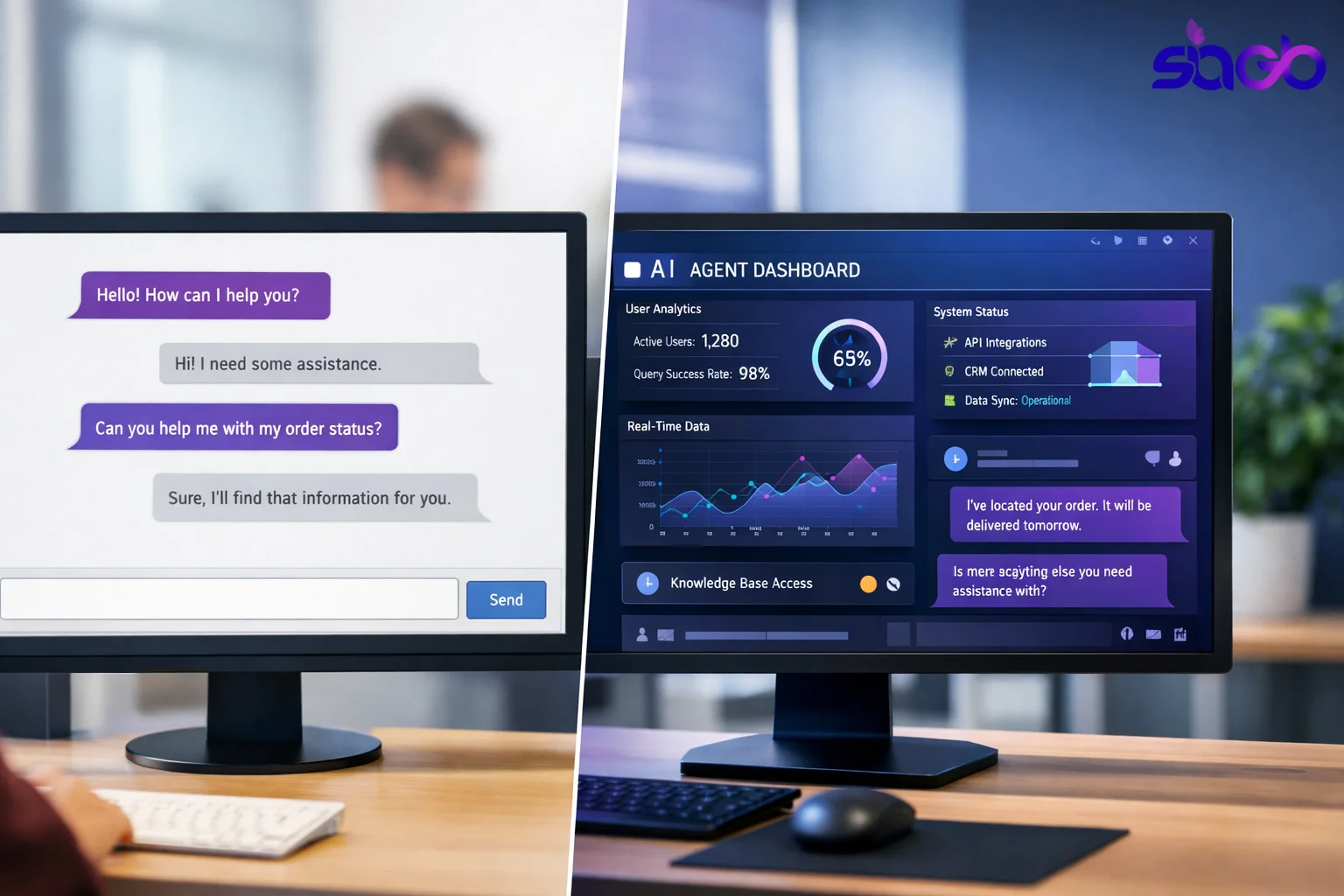
Quick answer: a chatbot follows a script. An AI agent thinks for itself. That’s the core difference, and it changes everything about what’s possible for your customer service operations.
But the real question isn’t which one is “better.” It’s which one is right for what you’re trying to achieve. The key differences between these two types of conversational ai go beyond just features. They shape your entire customer service strategy, your team’s workflow, and what your ai technology can actually accomplish.
Let’s break it down properly. If you’ve been Googling the difference between AI agent and chatbot, you’re not alone. It’s one of the most common questions we get from Australian businesses (especially here in Sydney) exploring artificial intelligence and agentic ai for the first time.
What Is a Chatbot?
A chatbot is a software programme that handles conversations based on predefined rules or decision trees. You’ve used them. You’ve probably been frustrated by them. “Press 1 for sales. Press 2 for support. Press 3 to repeat this menu.”
Traditional chatbots come in two flavours.
Rule-based chatbots follow rigid scripts. If a customer says “refund,” the bot routes them to the refund policy page. If they say something the bot doesn’t recognise, it says “I didn’t understand that. Can you rephrase?” We’ve all been there.
Keyword-based chatbots are slightly smarter. They scan messages for keywords and match them to pre-written responses. Better than nothing, but still limited. They can’t understand context, handle multi-step requests, or learn from past interactions.
About 85% of chatbots currently deployed by Australian businesses are still rule-based, according to a 2025 survey by Deloitte Australia. That number is honestly a bit depressing. They work for simple tasks like answering FAQs, providing store hours, or routing enquiries. But that’s where their usefulness ends.
The cost to set up a basic chatbot is relatively low, typically $2,000-$15,000 for a small to mid-sized business. That’s why they’re everywhere. But cheap doesn’t always mean effective.
What Is an AI Agent?
An AI agent is fundamentally different. It’s an agentic ai system powered by machine learning and natural language processing that can understand goals, reason about how to achieve them, and take autonomous actions to get things done. It doesn’t follow a script. It figures out what to do. Some people call them ai assistants, but that undersells what they’re capable of.
Think of the key differences this way. A chatbot is like a receptionist with a list of FAQs pinned to the desk. An AI agent is like a skilled customer service employee who understands the business, can access multiple systems, and makes judgement calls using natural language understanding.
Here’s what an AI agent can do that a chatbot can’t:
- Understand context. An AI agent reads the full conversation, understands what the customer actually needs (even if they don’t articulate it clearly), and responds appropriately.
- Take actions. It doesn’t just answer questions. It processes refunds, updates records, schedules appointments, generates reports, and escalates complex issues with full context.
- Learn and improve. AI agents get better over time. They learn from interactions, identify patterns, and refine their responses.
- Handle complex tasks. “Check my order status, apply the loyalty discount I was promised, and send me an updated invoice” is one request that an AI agent handles seamlessly. These complex tasks would make a chatbot fall over at step one.
- Work across systems. AI agents can connect to your CRM, inventory system, billing platform, and communication tools simultaneously, handling complex workflows that span multiple platforms.
Modern AI agents and chatbots typically handle 60-75% of customer service interactions autonomously, with a resolution rate that matches or exceeds human agents for routine customer service tasks. Generative ai powers much of this, enabling natural language responses that don’t sound robotic.
AI Agents vs Chatbots: The Comparison
Let’s put them side by side.
| Feature | Traditional Chatbot | AI Agent |
|---|---|---|
| Understanding | Keyword matching | Natural language understanding with context |
| Responses | Pre-written scripts | Generated dynamically based on context |
| Actions | Limited (route, respond) | Broad (transact, update, create, escalate) |
| Learning | None (static) | Continuous improvement from interactions |
| Multi-step tasks | Can’t handle | Handles complex workflows |
| System integration | Basic (1-2 systems) | Deep (multiple systems simultaneously) |
| Setup cost | $2K-$15K | $15K-$100K+ |
| Ongoing cost | Low | Moderate (API + maintenance) |
| Customer satisfaction | 45-55% average | 78-88% average |
| Resolution rate | 20-35% without human | 60-75% without human |
| Setup time | 1-4 weeks | 4-12 weeks |
| Best for | Simple FAQs, routing | Complex support, sales, operations |
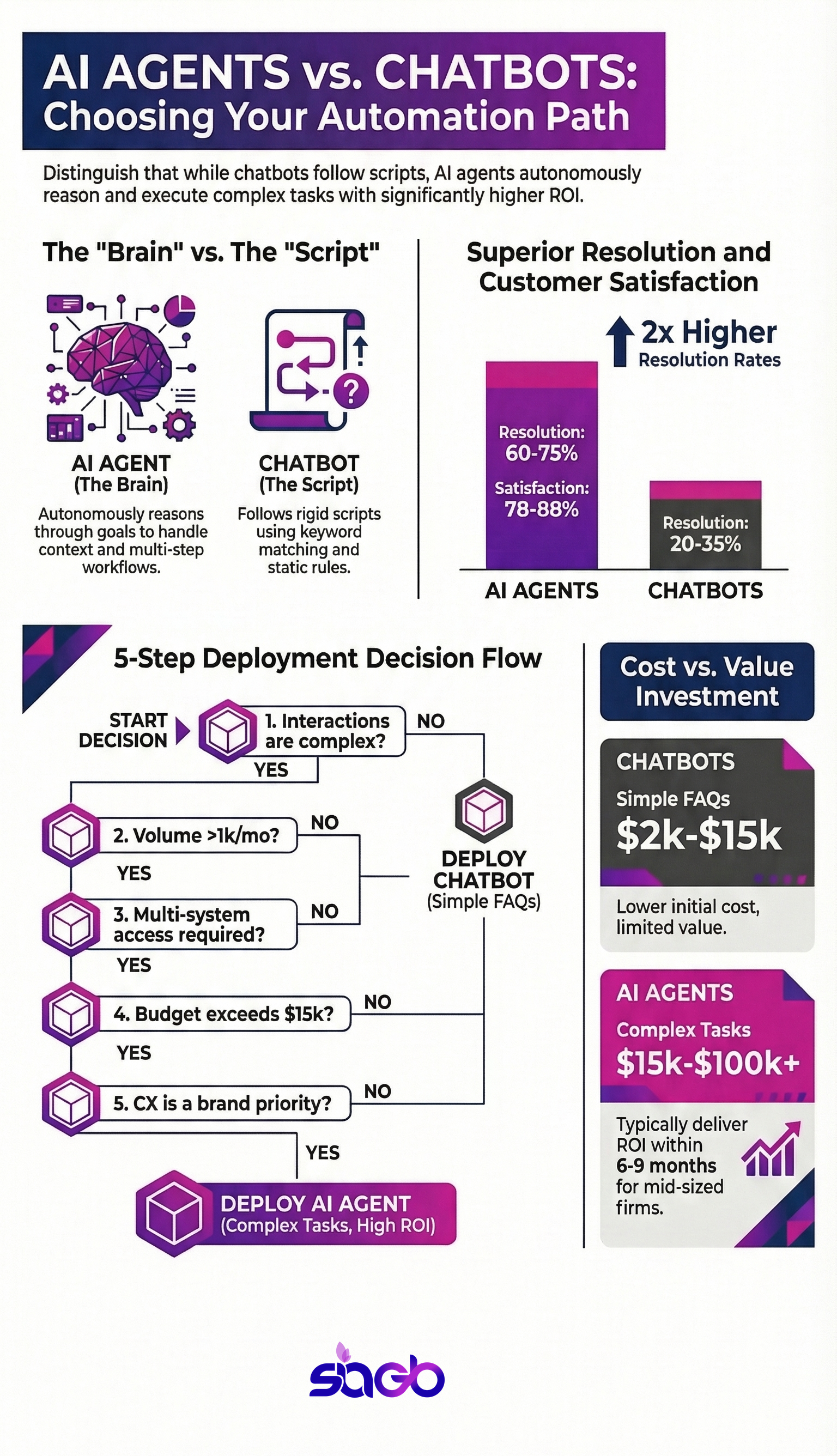
The numbers tell a clear story. AI agents cost more upfront but deliver significantly higher resolution rates and customer satisfaction. For businesses handling more than 500 customer interactions per month, the ROI usually favours AI agents within 6-9 months. (Timelines vary by industry, but this pattern is consistent across deployments.)
When Should You Use a Chatbot?
Chatbots still make sense in specific situations. Don’t let anyone tell you they’re completely obsolete.
Your customer service enquiries are simple and repetitive. If 80%+ of your customer questions are “What are your hours?”, “Where are you located?”, and “What’s your return policy?”, a well-built chatbot handles this customer service load perfectly. No need to overcomplicate things.
You have a very small budget. If you’re a small business with limited resources, a basic chatbot at $3,000-$5,000 is better than nothing. It can handle after-hours enquiries and free up staff time for more complex work.
You need something fast. Chatbots can be deployed in days. If you need a solution this week, not this quarter, a chatbot is the practical choice.
Your industry has strict compliance requirements. In some regulated industries, the predictability of scripted responses is actually an advantage. While AI agents are better in most cases, compliance-heavy environments sometimes benefit from predictable scripted responses. You know exactly what the bot will say, which makes compliance review straightforward.
When Should You Use an AI Agent?
AI agents are the right choice when your needs go beyond simple question-and-answer.
Your customer service interactions are complex. If customers regularly have complex tasks involving multi-step requests, need personalised responses, or require the system to access account data, an agentic ai agent is the only option that won’t frustrate them.
You’re handling high volume. Businesses processing 1,000+ interactions per month see the biggest ROI from AI agents. At that volume, even a 10% improvement in resolution rate translates to significant cost savings. E-commerce businesses typically save $8,000-$25,000 per month after deploying AI agents for customer support.
You want to reduce headcount dependency. Not eliminate humans, but free them up. AI agents handle the routine 70% so your team can focus on the complex 30% that actually needs a human touch.
You need complex workflows across systems. When a customer service interaction requires checking the CRM, updating the billing system, and sending a confirmation email, only an AI agent can handle that workflow in a single conversation. Traditional chatbots simply can’t manage these complex workflows.
You’re ready to invest in AI integration properly. AI agents aren’t plug-and-play. They need proper setup, training data, system integrations, and ongoing refinement. If you’re committed to doing it right, the returns are substantial.
Real-World Examples
Example 1: E-commerce Customer Support
A mid-sized Australian online retailer was using a rule-based chatbot for customer support. The chatbot answered basic questions but couldn’t handle returns, order modifications, or shipping issues. Result: 72% of chatbot interactions ended with “Let me connect you with a human agent.”
They replaced it with an AI agent connected to their Shopify store, shipping provider, and CRM. The agent now processes returns, modifies orders, tracks shipments, and handles complaints autonomously. Human escalation dropped to 28%. Customer satisfaction scores went from 52% to 84%.
Example 2: Healthcare Appointment Management
A medical practice group with 12 clinics was using a basic chatbot for appointment bookings. Patients could only book standard appointments through the bot. Anything involving rescheduling, multi-provider visits, or insurance questions required a phone call.
Their AI agent now handles the full appointment lifecycle. It checks provider availability across all 12 clinics, considers patient preferences and insurance coverage, sends reminders, manages cancellations, and even pre-screens for urgency. Phone call volume dropped 45% (which is saying something for a 12-clinic operation), and front desk staff were reassigned to patient care roles. Similar results have been reported by clinics across Sydney’s Northern Beaches and inner west.
Example 3: Professional Services Lead Qualification
An accounting firm was losing potential clients because their website chatbot could only say “Please fill out our contact form and we’ll get back to you within 24 hours.” By which time, the prospect had already contacted three competitors.
Their AI agent now engages prospects in real conversation. It asks about their business size, current accounting setup, pain points, and goals. It qualifies leads against the firm’s ideal client profile, books discovery calls directly into the partners’ calendars, and sends a personalised summary to the assigned partner before the call. Qualified lead conversion increased by 38%.
What About Voice AI?
Here’s a question many businesses overlook: does your AI need to talk, not just type?
Voice AI is a growing category that blurs the line between chatbots and agents. Modern voice AI systems can handle phone calls, understand accents (including Australian English, which has historically been tricky for voice recognition systems), and complete transactions verbally.
If a significant portion of your customer service interactions happen by phone, voice-enabled AI agents are worth considering. They combine the conversational ai ability of AI agents with the accessibility of a phone call. Well-configured voice AI deployments typically handle 50-65% of inbound customer support calls without human intervention.
The Hybrid Approach
So, do you need to choose one or the other? Not necessarily. Many businesses run a hybrid setup.
A lightweight chatbot handles the simplest interactions (hours, location, basic FAQs) at minimal cost. An AI agent handles everything more complex. The chatbot serves as the first touchpoint and escalates to the AI agent when the conversation requires reasoning, actions, or system access.
This approach keeps costs down while still providing a premium experience for customers with complex needs. It’s the best of both worlds for businesses that aren’t ready to go all-in on AI agents.
The key is getting the handoff right. Remember that 60% stat about bad bot experiences driving customers to competitors? A clunky transition between chatbot and AI agent (or AI agent and human) is exactly how you create one of those bad experiences. The conversation context needs to flow seamlessly between layers.
How to Decide: A Simple Framework
Ask yourself these five questions:
- What percentage of your customer interactions are simple vs complex? If 80%+ are simple, a chatbot might be enough. If more than 30% are complex, you need an AI agent.
- How many interactions do you handle monthly? Under 500? Chatbot is fine. Over 1,000? AI agent ROI becomes compelling.
- Do interactions require accessing multiple systems? If yes, AI agent. Chatbots can’t do this effectively.
- What’s your budget? Under $10K? Chatbot. $15K-$100K+? AI agent territory.
- How important is customer experience to your brand? If customer experience is a competitive differentiator, invest in an AI agent. If it’s a cost centre to minimise, a chatbot will do.

Thinking about how this applies to your business?
Start a Conversation